GIRONA TO AFRICA: THE HIDDEN BRIDGE BEHIND AN ERASMUS+ STORY
Beyond Borders: An African Participant’s Reflection on the Erasmus+ Mobility Experience
Introduction
Some towns you visit and forget. Others stay with you long after you’ve left. Girona is the second kind.
I landed in Barcelona in the quiet hours of a Tuesday morning, and before long I was in Girona itself, a small town carrying more than a dozen centuries of history, still lovingly kept by the people who live there.
A Town Built on Stone, Time, and the River
Girona doesn’t show off. It reveals itself slowly, one cobbled street at a time. The old town climbs a hill above the Onyar River, its pastel houses leaning over the water in the kind of scene that ends up on every postcard of Catalonia.
Roman walls still circle much of the old town, and you can walk along the top of them and look out over the rooftops and the hills beyond. The medieval center is still intact: narrow stone alleys, arcaded squares, and old gates that have seen centuries of sieges and shifting rule. Running through it all is the Onyar, crossed by small bridges, its colors reflected in the water every morning.
Just outside town, the countryside is dotted with old castles, hilltop fortresses that once guarded this valley and still stand today as reminders of how long this land has been fought over and loved.
The University of Girona: An Ancient Name, a Renewed Purpose
At the heart of the town is the University of Girona, and like the town itself, it is old at its roots and new in its form. Its earliest version, the Estudi General, was founded in 1446 by King Alfonso the Magnanimous, who gave Girona the right to award degrees in philosophy, law, and medicine. That university thrived for centuries before it was shut down in the 1700s during Catalonia’s political upheavals.
It took more than two hundred years to bring it back. After decades of effort, built on the foundation of a local teachers’ college, the Catalan Parliament finally approved the modern University of Girona in December 1991.
Today it is spread across several campuses, with its historic home still standing in a sixteenth-century building in the old town, the very spot where the original classes were once held. It now has nine faculties, from sciences to law to medicine, and serves more than 15,000 students.
It is a university where nearly six centuries of history meet a modern, outward-looking institution, one that reaches, through programs like Erasmus+, far beyond Catalonia.
Professor Jaume: The Bridge Between Girona and Africa
But no history and no building really explains what makes a visit to Girona unforgettable. That comes down to people, and here, to one person in particular: Professor Jaume.
If Girona is a bridge between centuries, Jaume is a bridge between continents. Quietly, without much fuss, he has become the link between Africa, the Erasmus+ program, and the University of Girona, turning what could easily be a cold, bureaucratic exchange into something genuinely human.
Jaume is a humble man. He is the kind of person you could call late at night, feeling bad for even doing it, and he would still pick up, wide awake, ready to help.
When the Spanish visa process gets in the way, as it often does, he sorts it out himself: moving invitation dates around when an embassy appointment falls through, redoing paperwork to match whatever new dates work. Watching him solve these problems, his guest got to see, up close, how a first-world university actually runs, not from the outside, but from right in the middle of it.
His care does not stop at paperwork. He drove 240 kilometers round trip, from Girona to Barcelona and back, just to pick up his guest from the airport himself rather than leaving it to a shuttle.
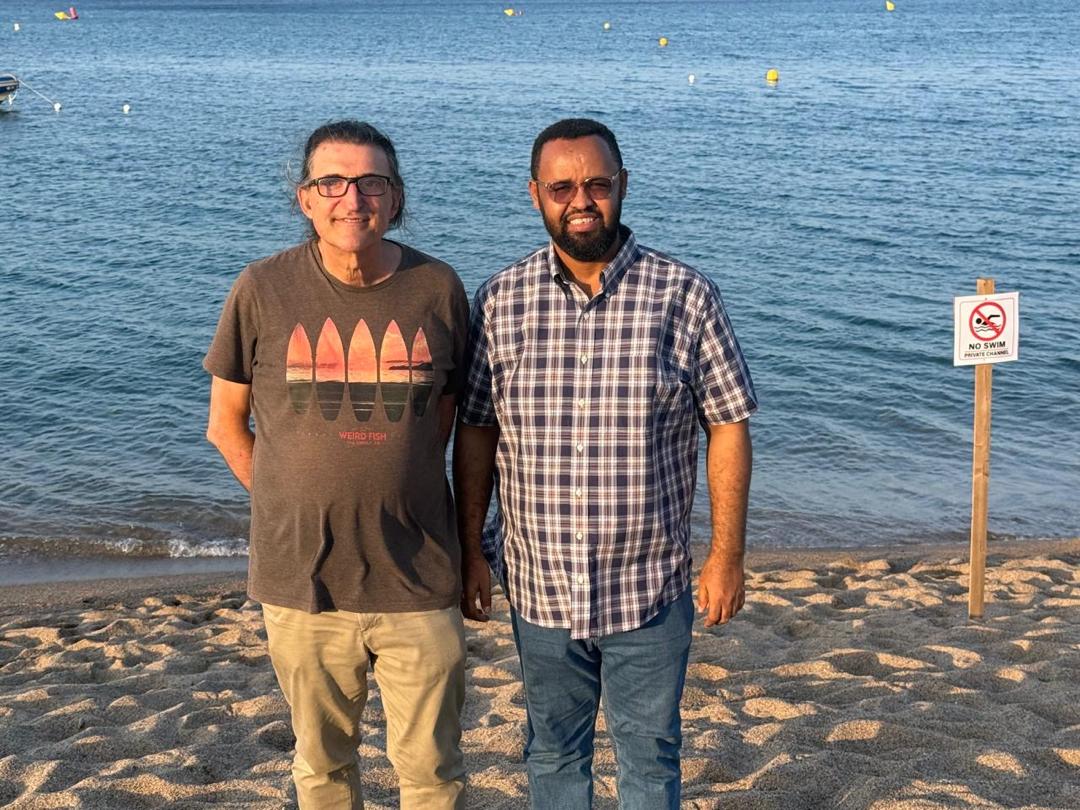
And after a full day of receptions, meetings, and academic exchanges, tiring enough on its own, he was still Jaume: inviting his guest to dinner at a beach 42 kilometers away, near his own home.
On the drive there, he slowed down through village after village, pointing each one out and telling its story. At one, he stopped the car completely and walked his guest through its old castle and fortified walls, medieval history you could actually touch, not just drive past.
At the beach, he paid for dinner and stayed late talking, before driving everyone back and dropping them home well past one in the morning, knowing he had another full day starting just hours later.
That is a kind of greatness that has nothing to do with titles or publications. Jaume is a scholar, but he is a caretaker first. His generosity says more about him than his CV ever could.
In a world where exchange programs so easily become paperwork and checkboxes, he treats every guest, an African visitor arriving through Erasmus+, as family, not a file.
Girona will be remembered for its Roman walls, its castles, its houses along the river. But for anyone fortunate enough to meet him, it will be remembered most for Jaume.
A Note of Gratitude
My sincere thanks go first to the Vice-Rector for International Affairs, Dr. Josep Vila Subirós, for his warm welcome and his support of this exchange.
I am equally grateful to Professor Jaume, for his generosity, patience, and unwavering support throughout this journey, and to his wife, whose warmth and humility mirror his own, and who welcomed the team with a ride on our very first day and joined us for dinner by the beach.
I would also like to extend my gratitude to the University of Girona as an institution, for its openness, professionalism, and the warmth with which it welcomed its Erasmus+ guests, and to the European Commission, for the invaluable opportunity provided through the Erasmus+ Mobility Programme.
Finally, my thanks to the rest of the university staff and to every Erasmus+ participant who made this experience one to remember for a lifetime.
Idiris M. Hamud
Erasmus+ Mobility Programme Participant